
A Google Workspace-native intranet approach that reduces vendor complexity, keeps data in your domain, and makes privacy reviews simpler.
By Dr. Peter Chadha, Google Workspace Transformation Leader

Recently, we were asked to complete a Data Privacy Agreement as part of a vendor onboarding process for a school.
That is not unusual. Schools and districts are quite rightly becoming more careful about who can access their systems, what data is involved, and where that data goes. Before a new tool is approved, IT, legal, compliance, and the district's data protection officer often want clear answers — and in many states, a formal DPA is a legal requirement before any vendor can touch student or staff data at all.
But as we worked through the document, something became very obvious. A lot of Data Privacy Agreements are written with a particular type of vendor in mind: one that takes your data, stores it on its own platform, processes it in its own environment, and keeps a copy of it somewhere outside the district. For many education software vendors, that is exactly what happens. For Steegle.One, it is not.
The Problem With Many Vendor Privacy Agreements
A typical school DPA asks perfectly sensible questions:
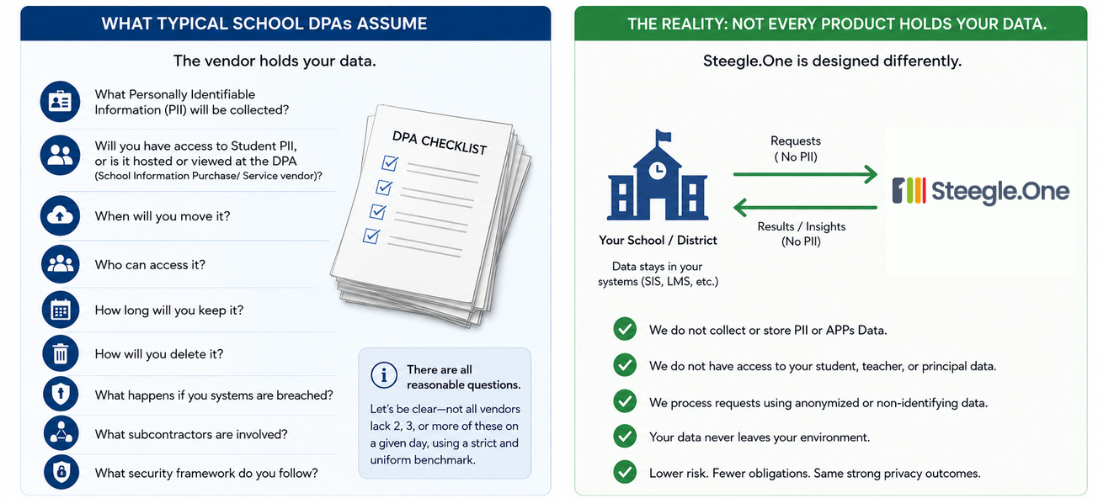
These are all reasonable questions, and frameworks like New York's Education Law 2-d spell most of them out explicitly, right down to defining PII and APPR Data in the contract itself. The difficulty is that these questions assume the vendor is holding the district's data in the first place. That makes the process heavier than it needs to be when the product does not work that way. In our case, some of the questions felt more complicated than the actual risk. Not because the questions were wrong, but because Steegle.One is designed differently.
The Key Difference: Steegle.One Runs Inside Google Workspace
Steegle.One is built for schools and districts that already use Google Workspace for Education. Rather than taking your intranet content, directory data, files, and staff information into a separate Steegle-hosted system, Steegle.One works inside your own Google Workspace environment. You can see how that's architected on our Security page.
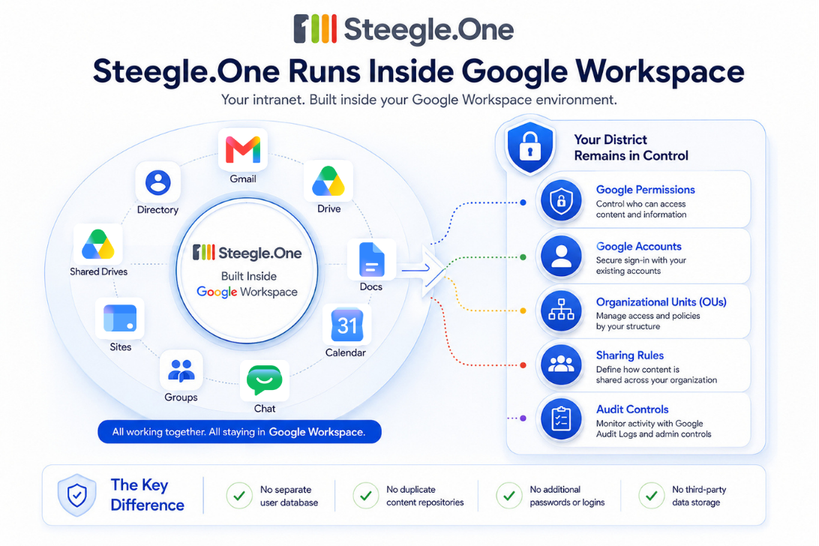
For a school or district, that means student PII, staff records, safeguarding information, and internal policy content does not need to be copied into another standalone platform just to power an intranet. If a legacy Google Site is being revamped and Steegle.One installed on top of it, the underlying data stays exactly where it already lived, inside the district's own Workspace.
Why This Matters When Signing a DPA
When a vendor hosts your data on its own platform, the DPA conversation becomes longer. The district needs to understand the vendor's hosting, backups, retention policy, deletion process, breach exposure, access controls, support access, subcontractors, and disaster recovery arrangements — for every category of PII the vendor might touch, APPR Data included. That may be appropriate for some systems.
But if the data does not need to leave your Google Workspace environment, many of those questions become much simpler. Asking "where is Student PII stored" has a very different answer when the honest reply is "nowhere — it never left your Workspace" rather than a description of a separate vendor-hosted database. With Steegle.One, the conversation is different because the underlying architecture is different.
The answer is not: "We take your Workspace data and store it in our system."
The answer is closer to: "Your data remains in your Google Workspace. Steegle.One works with it there, and access to anything resembling PII is incidental at most — not something we go looking for."
That is a much cleaner starting point for IT, legal, compliance, and procurement teams, and it shows up directly in how a DPA's Exhibit B and data security plan get filled out: shorter, more concrete answers, fewer hedges.
The Lesson From the DPA Process
Working through a vendor privacy agreement reminded us of something important:
A DPA is not just a legal document. It is a test of the product's architecture.
If the vendor stores everything, the DPA has to work very hard.
If the product is designed to keep the district's data in the district's own environment, the conversation becomes clearer — and questions about Student PII and APPR Data stop being the hardest part of the form.
That is one of the reasons Steegle.One was built the way it was.
What to Ask Before You Sign
Before approving any intranet, employee directory, file-sharing, or internal communications platform, ask:

Does this tool copy our data into the vendor's own platform?
Does the vendor hold a separate copy of our directory, files, or intranet content?
Will the vendor have access to Student PII or APPR Data, and if so, how is that access limited?
Can we control access through our own Google Workspace admin settings?
Is vendor access ongoing, or limited to agreed implementation and support periods?
What data remains with the vendor when the contract ends?
If the answers are vague, the DPA may become harder than expected. If the answers are clear, the process usually moves faster.
The Takeaway
We do not see Data Privacy Agreements as a nuisance. They are an important part of responsible vendor management, and for schools and districts handling Student PII and APPR Data, they're often a legal requirement, not a courtesy. But they also reveal whether a product has been built with privacy, governance, and district control in mind.
For schools and districts using Google Workspace, Steegle.One makes the conversation easier because it works inside your existing environment rather than creating an unnecessary separate copy of your data. You can see how this has played out for other districts in our case studies. Your data stays in your Google Workspace. Steegle.One works with it there. That is a simpler story for IT, legal, compliance, procurement, and district leadership.
Frequently Asked Questions
-
A DPA is a contract that sits alongside a vendor's main service agreement and governs how that vendor handles Personally Identifiable Information (PII) belonging to students, parents, teachers, or staff. In New York, for example, Education Law 2-d requires one before a third party can access PII at all.
-
No. Steegle.One runs inside your own Google Workspace environment rather than on Steegle-hosted infrastructure. There is no separate copy of your directory, files, or intranet content sitting on Steegle's side.
-
APPR Data refers to Teacher or Principal Annual Professional Performance Review records, a specific category of PII defined under New York Education Law. Steegle.One's access is limited to a legacy Google Site and related intranet content for implementation and support, so access to APPR Data is not expected and not intended.
-
Access is limited to defined service windows — implementation, configuration, support, and training — rather than being continuous or ongoing. It is not a standing connection that stays open after the work is done.
-
Yes. Because Steegle.One operates inside your existing Workspace rather than a separate platform, your own permissions, organisational units, and sharing rules remain the actual control point — the same way they would for any other Workspace user or app.
-
Because Steegle does not hold a separate copy of your data, there is nothing to migrate back. Access is simply removed, and your Google Workspace, Sites, and intranet content remain exactly where they always were.
Have a question we haven't covered here?
Our full FAQ page has more on implementation, security, and pricing.
If your school or district is reviewing intranet options and needs to understand the DPA position, book a discovery call. We'll walk you through how Steegle.One works inside your Google Workspace environment and why that matters for privacy, security, and governance.
